Today, I sat down to reflect on how I used to think before AI and how I think now. I realised that, before AI became a regular part of my life, almost every curiosity could turn into a research project. I would search the internet, explore different sources, read opposing perspectives and gradually form my own understanding. Sometimes I found answers. Sometimes I found more questions. And sometimes, after exploring different perspectives, I’d change my mind.
The process took time, but I enjoyed it. There was something satisfying about discovering things for myself. Today, that process looks different. When something makes me curious, I can simply ask AI to research it for me. Within seconds, I have explanations, summaries and perspectives that might once have taken me hours to find. And I enjoy it even more as I feel my precious time is saved.
And this is remarkable.
But it makes me wonder: Are we changing the way we think, or simply changing the way we find answers?
Are we becoming so accustomed to instant explanations that we are losing patience with the slower process of thinking things through ourselves? Are we beginning to rely on AI not only for information, but also for validating our reasoning and judgements? I wanted to explore these questions without AI influencing my thoughts.
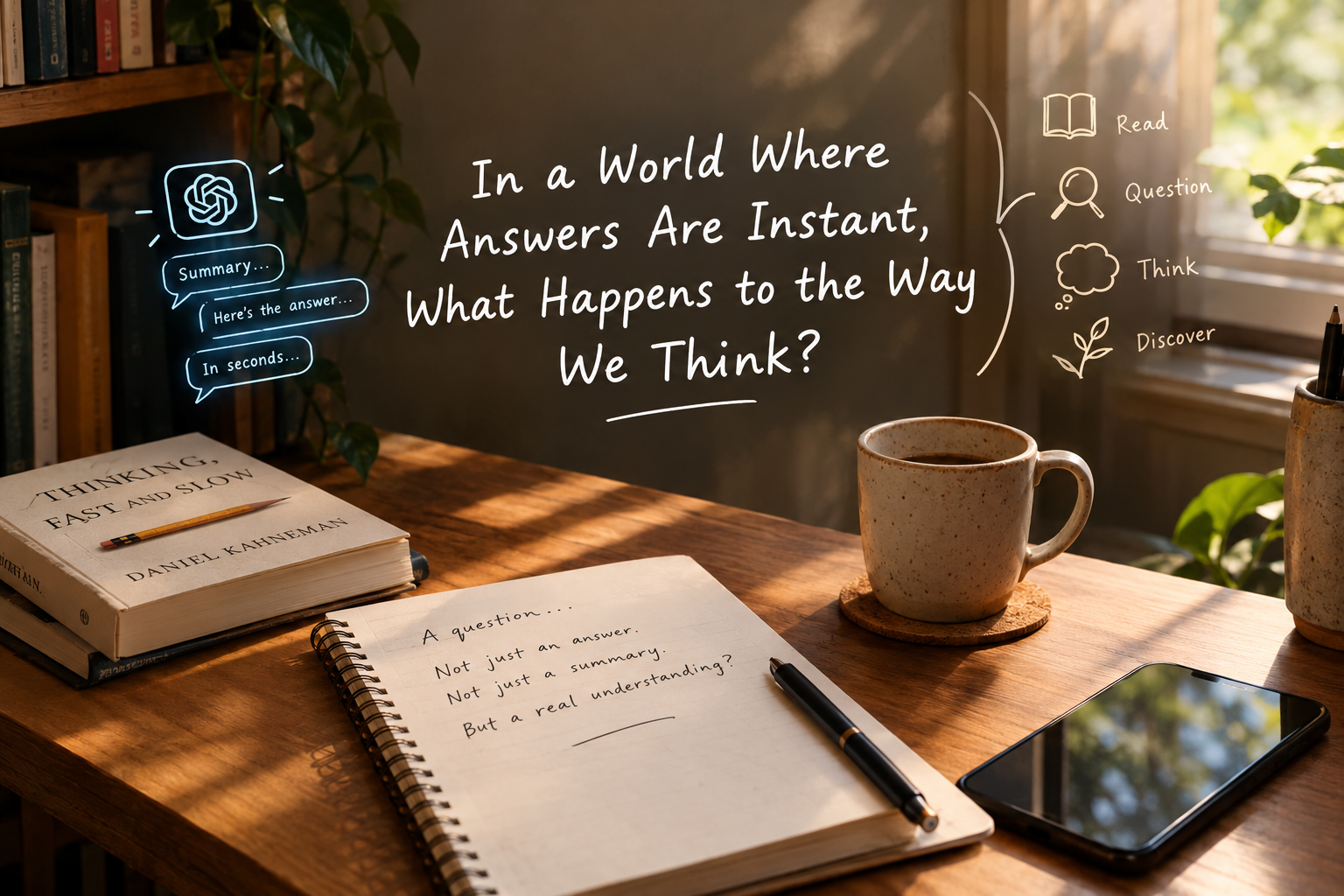
So, I put my phone aside, took a pen and paper, and tried to write down my thoughts.
However, putting my thoughts into words felt harder than I expected.
I used to blame writer’s block when I struggled to articulate my ideas. This time, though, I wondered whether I had become so accustomed to AI helping me organise and develop my thoughts that doing it independently had started to feel unfamiliar.
I couldn’t say for sure. Perhaps I was out of practice or simply overthinking. But the possibility intrigued me. I wanted to return to the experience of researching something on my own. No AI, no internet search. Just my own curiosity and the resources I already had. And then I noticed Daniel Kahneman’s Thinking, Fast and Slow staring at me from the bookshelf, almost as if it were teasing me:
“Girl, you’ve read me. Why are you struggling to figure this out?”
Suddenly, I felt that little lightning buzz of excitement.
I reached for the book, and it struck me that perhaps this was exactly what I had been missing: not another instant answer, but the excitement of following a question wherever it might lead.
What happens when thinking becomes effortless?
As I started connecting Kahneman’s explanations with my own habits, I began to see my everyday use of AI a little differently. Kahneman describes two modes of thinking: one that is fast, automatic and effortless, and another that requires attention, concentration and deliberate effort. And I started wondering, how often I now let AI do the work that I used to do myself. A curiosity that once sent me searching through websites, reading different perspectives and connecting ideas can now be answered in seconds. I get an explanation, reach what feels like a conclusion, and move on.
But what happens to everything in between? The searching, the questioning, the moments when one idea leads to another, when something doesn’t make sense, and when I have to reconsider what I thought I knew?
Perhaps those moments weren’t just obstacles between me and an answer. Perhaps they were part of how I learned to think. Perhaps those were the journey of my learning and unlearning things. Of course, AI can help us think more deeply, too. It can challenge our assumptions, introduce unfamiliar perspectives and help us see connections we might otherwise miss. I’m not suggesting that using AI is wrong or it just blocks our thought process.
But I began to wonder whether, as answers become easier to obtain, we might become less willing to do the difficult work of thinking things through ourselves. And that thought led me to another idea in Kahneman’s book. The way our minds respond to information that feels easy to process. Think about it. When something is explained clearly, when the words make sense and everything seems to fit together, we tend to feel comfortable with it. Sometimes, that comfort makes an idea feel more convincing than it deserves to be. And isn’t that interesting when we think about AI?
AI can take a complicated topic and explain it so neatly that, by the time we finish reading, we feel like we understand it. The answer sounds logical. The reasoning seems clear. We might even feel more confident about our own opinion. But did we actually examine the reasoning? Did we consider other perspectives? Or did the explanation simply make it easier for us to accept the conclusion? How often do I ask AI, to evaluate my thoughts, challenge my opinions or tell me whether my reasoning makes sense? There is nothing inherently wrong with that. Sometimes, another perspective is exactly what we need.
But what happens when we start looking for validation before we have given ourselves enough time to question our own thinking? I don’t have a definite answer. But I can see how easily a tool designed to make things easier could also make us less inclined to question what feels right.
Are we becoming better at finding answers but less comfortable with uncertainty? What happens if AI is uncertain for our questions ?
Another connection I made with Kahneman’s work is how we sometimes replace a difficult question with an easier one without realising it. I wonder whether we do something similar when we turn to AI.
We begin with a question that is complicated, uncertain or difficult to work through. We ask AI to explain it, and suddenly we have something clear and structured in front of us. But sometimes, the uncertainty is part of the question. Sometimes, we need to sit with it a little longer before we can even understand what we are trying to figure out.
When we rush towards an answer, we might miss the opportunity to discover that our original question was wrong, our assumptions were incomplete, or there was something else we hadn’t considered. And maybe that is what I was trying to get back to when I put my phone aside and picked up a pen. I was not looking for grand answers but I wanted more space so that answers would make way into my though processes.
Of course, Kahneman wasn’t writing about AI, and these connections don’t prove that AI is changing our ability to think. They are questions, I found myself asking as I connected his ideas with my own habits. But they leave me wondering whether, in making the search for answers easier, we also need to be more deliberate about preserving the thinking that happens along the way.
So, what do we do with this? Can we actually do this ? I wonder if we could do this !
I don’t think the answer is to stop using AI. That would be ignoring a tool that can help us learn, create and explore ideas in ways we couldn’t before. But perhaps we need to be more conscious and mindful. What if, sometimes, we allowed ourselves to sit with a question before asking for an answer? What if we formed our own opinions before asking AI to challenge them? What if we occasionally chose a book, followed a reference, or simply let our thoughts wander without immediately looking for an explanation?
Not every question needs hours of research, and there is nothing wrong with making life easier. But I don’t want convenience to take away the excitement of discovering something for myself.
When I put my phone aside and picked up the pen, I was not and am not trying to prove that AI was making me think less. I was trying to understand why thinking independently had suddenly felt different.
I still don’t know whether AI has changed the way I think, or whether my habits have simply changed or whether its just adulthood with all its responsibilities slowly pushing my creativity into the background . That might be another question to explore or Perhaps the answer lies somewhere in between.
But I do know that the experience made me pause and pay attention to something I might otherwise have overlooked.
Finding an answer and understanding an answer are not necessarily the same thing. Neither are receiving a perspective and developing our own. In a world where answers are instant, perhaps the knowing how to find answers is not just enough but to question them, looking beyond them and putting everything aside and thinking for ourselves. Because I don’t want to lose the part of curiosity that makes me want to follow a question simply to see where it leads.
And maybe that’s what I want to hold on to: not the ability to find answers quickly, but the willingness to keep asking questions.
I’m curious: Have you noticed a change in the way you think, research or form opinions since you started using AI?